Wednesday, February 12, 2014

Discovering an Oasis: Valle de Elqui

In the two years we've lived in Chile, we have always traveled south from the city, or right around the city (or out of the country), but just recently we decided to check out Valle de Elqui in the north of Chile.


Trip "fishes" in Valle del Elqui


Getting There: Elqui Valley


Although they have direct flights to La Serena, which is nearby, we drove the eight hours north to Valle del Elqui. The trip was very pretty because Ruta 5 north travels alongside the coast most of the time, offering great views of the beach towns and ocean, and we got to stop along the way at a very famous cheese and papaya roadside store.

The trip from Santiago to Valle de Elqui
(map courtesy GoogleMaps)


Hacienda Huentelauquen is a roadside restaurant that sells papaya juice, canned papayas, mantecoso cheese (a light, white, creamy cheese) and fried cheese empanadas. Now with the most expensive mantecoso in the grocery stores throughout Santiago, Hacienda Huentelauquen was really just a humble roadside store, but now it has a huge line of cars waiting to park, and a huge line of Chileans waiting to eat empanadas by the kilo.

It was a perfect stop along the way to take us to the coastal town of La Serena, where we hit the grocery store (thankfully because goods were hard to procure once you entered the valley), and basically turned right towards the mountains, and headed toward Valle de Elqui.


The Juice on Valle de Elqui


So, Elqui Valley was a huge surprise to us. We had heard to go there, and we had heard that the sky is so clear at night that you can see multitudes of stars, but we didn't know much more than that.


Stark Contrast: Green vineyards in the middle of the desert


In fact, Valle de Elqui is a narrow valley between the Andes mountains that was formed by the Elqui River. The mountains on either side of the valley are dry and desert-like, but because of the river and very smart irrigation, the valley is filled with bright green vegetation.

In Elqui Valley there are fields and fields of perfectly manicured vineyards, and the grapes are mostly used for the local favorite, pisco, which is a grape-based brandy and the main ingredient in pisco sours. They also cultivate papayas, which are different from the ones I grew up with in the Rio Grande Valley, as they are smaller and sweeter, and the meat is yellow instead of salmon-colored. It looked like they also had a fair amount of olive trees and avocado trees, which are also very popular throughout Chile.


Morning clouds dancing on the mountaintops


The main town in Valle de Elqui is Vicuña, but the area is dotted with a number of tiny little pueblos that seem to be built into the sides of the mountains -- whereas the prime real estate (the valley floor) is allocated to the vegetation.

What to Do


The valley is supposed to be very spiritual, with many people saying it has healing powers. I don't really know about that, but I can say that it is breathtakingly beautiful, truly an oasis, and when the sun goes down, the sky becomes so bright with millions of stars.

Nonetheless, there are a ton of interesting yoga, meditation, massage places and retreats, as well as many observatories where you can take a tour of the stars.


Patrick fly fishes in Elqui River, Valle de Elqui


In addition to the star-gazing, my favorite thing about this trip was the river. We spent a splendid afternoon playing in the river just steps from the cabins where we stayed. Trip and I "swam" (basically waded), and Patrick and our friend Judy fly fished.

Interesting to note: Famed Chilean poet, feminist, educator and diplomat Gabriela Mistral (aka Lucila Godoy Alcayaga) is from Vicuña, and she serves as the only Latin American woman to have ever won the Nobel Prize in Literature (1945).


Life is good


Thursday, January 30, 2014

What an Adventure: Visiting Lima, Peru

So this post is a tad bit late coming, as we went to Lima, Peru more than a year ago, but beggars can't be choosers, and at least I've gotten around to it now.

My company, BNamericas, had an event in Lima focused on energy, and as an old oil writer, I got to go to check out our events and cover the event, too. Because of that, we decided to wrap a little family trip together and stayed over the weekend. It was a quick trip, but I fell in love with Peru in about a minute and a half, and I can't wait to go back!


Plaza de Armas (or Plaza Mayor) was founded by conquistador Francisco Pizzaro in 1535.

Let me give you some quick take-aways from Lima, and then we'll get to some of the great spots we discovered. First off, while Santiago is decidedly European, Lima is exactly what you picture when you think of Latin America -- hot, sweaty, amazing foods, lively music spilling from windows and the friendliest people you could ever have the priviledge of meeting.


Kitties hanging out with the Virgen Mary.


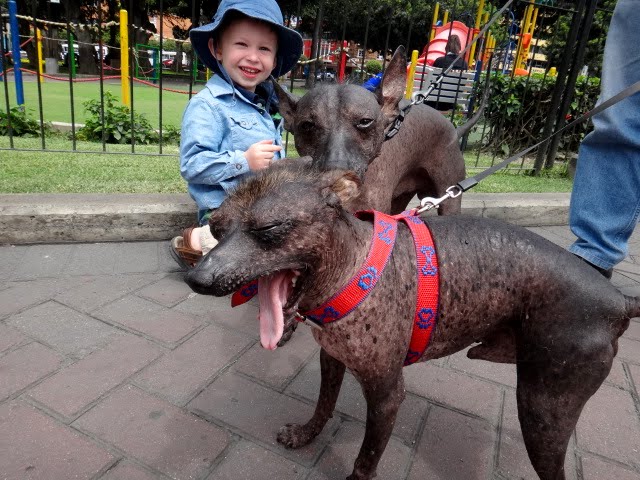
While Santiago is filled with stray dogs, Lima is filled with stray cats, and they lounge throughout the parks and add a bit of character to the city. Additionally, Peru has an ancient dog that was the pet of pre-Inca cultures there. While the people seem to be extremely proud of their hairless ancient pets, I have to say, they are quite ugly.

Trippie doesn't seem bothered by their looks.


We stayed at this lovely and inexpensive bed and breakfast in the San Isidro district called Casa Bella B&B. The hotel is boutique (read: just a couple of rooms) and has been transformed from an old mansion. The people there are extremely helpful, the grounds offered a lovely patio garden where we could sit and let Trip play outside, and the location was a great jumping off spot for exploring Lima.


Ancient Huaca Pucllana pyramids in Miraflores, Lima.

The capital city of Peru, Lima is on the coast of the Pacific. While Miraflores is one of the most upscale neighborhoods overlooking the waters, this modern city is juxtaposed with ancient relics and pyramids from the native people who lived there centuries ago sprinkled throughout the city.


Loads of surfers come to the beaches of Lima to take advantage of the gnarly waves.


One of our favorite discoveries in Lima was the neighborhood of Barranco, which hosts a lovely mix of old buildings, beautiful vistas, bohemian artists, inexpensive B&Bs and lots of bars and restaurants. Founded in 1874, Barranco reminded me of a less commercialized San Antonio River Walk, but exchange the river for the ocean.


Phaedy and Trip on the Bridge of Sighs in Barranco, famous for granting wishes


Also, we got to go to the amazing Magic Water Circuit, which is in Reserve Park and a definite must-see. We didn't really know what we were getting into, but had just heard to go, and boy were we in for an amazing surprise. The public park transforms at night with all the fountains showcasing water, lights and music. It was breathtaking to watch lights transform over the fountain into ice skaters dancing and beautiful cultural dances.


The Troys at the Magic Water Circuit.


Although it's decidedly touristy, we booked an afternoon on a tour bus that drove us around Lima and stopped at the beautiful Museo Larco, which houses one of the largest collections of pre-Columbian art in an amazing 18th centrual mansion.


Museo Larco


I really enjoyed getting to sit in the open-air double-decker bus and see all sorts of neighborhoods and hear the history while Trip napped, and he woke up just in time for the museum, which also had a lush garden that he enjoyed playing in.


Not too shabby! The Troys get to see Lima in a couple of hours (and not get lost)

Truly, you can't talk about Peru and not talk about the food (which is exquisite) and the pisco sours; nonetheless, that is a post for a different day because I could go on an on about the culinary experience that is Peru. So I leave you with a shot of us enjoying a Peruvian pisco sour at Museo Larco, and I definitely will drink to your health!

¡Salud! A happy family enjoying pisco sours at Museo Larco in Lima, Peru.